A capacitor bank fuse failure calls for an investigation before the bank is returned to service. Identify the protected circuit, preserve the event evidence, and have a qualified team assess the capacitor stage, connections, switching arrangement and protection. Replacing an open fuse without understanding its operation can leave the original problem in place. This guide covers a low-voltage industrial power-factor correction cabinet: how to organize the investigation, distinguish observations from conclusions, and prepare a defensible replacement request. It does not provide a live-testing procedure or a universal fuse rating.
Start with the assembly drawing and the physical circuit designation. A main supply fuse, a control-circuit fuse and a stage fuse protect different boundaries. An alarm naming a stage does not establish which component failed. Record the cabinet identity, drawing revision, stage designation, affected phase, fuse markings and the indication that led to the discovery. Preserve photographs taken under the site’s safe-access arrangements.
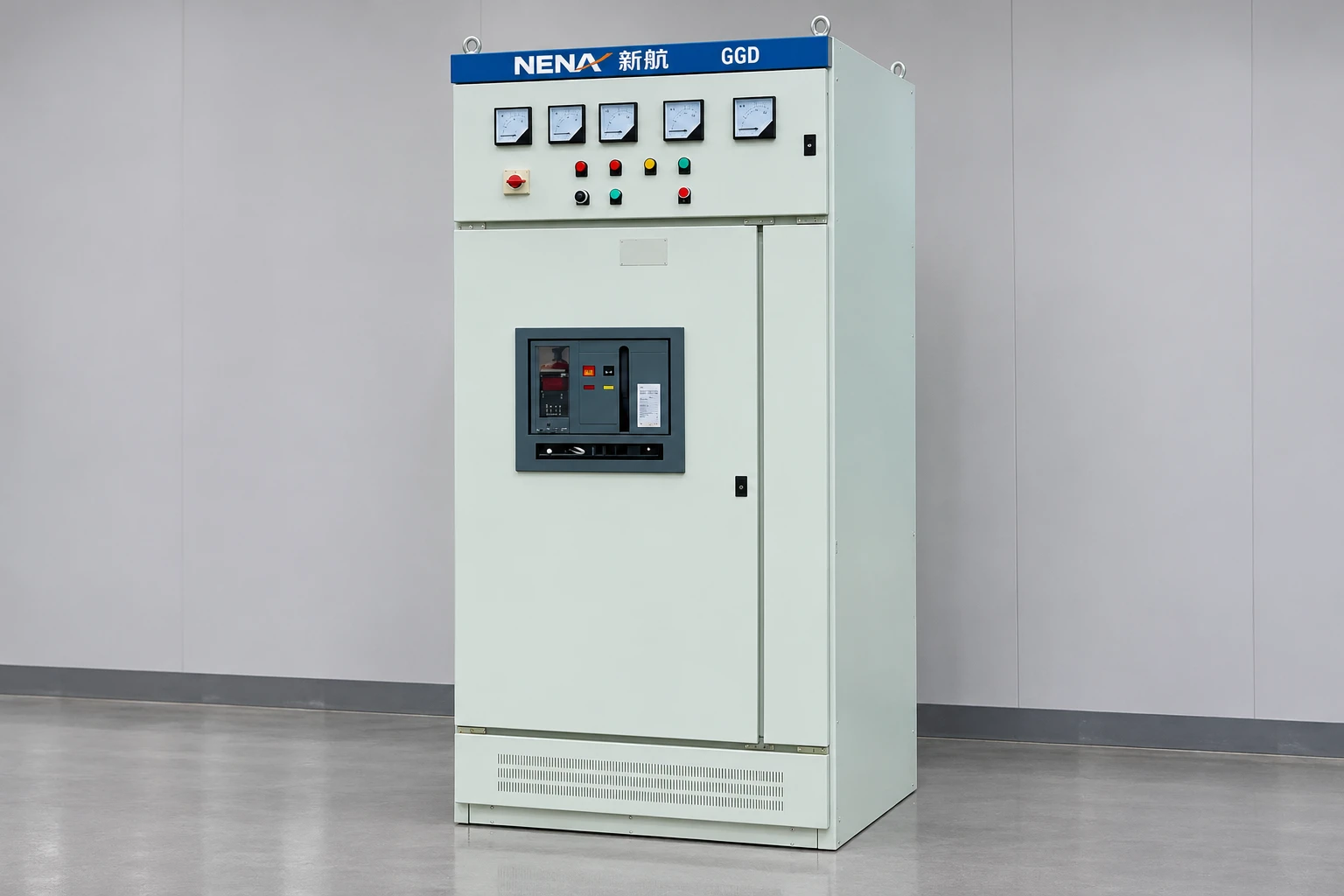
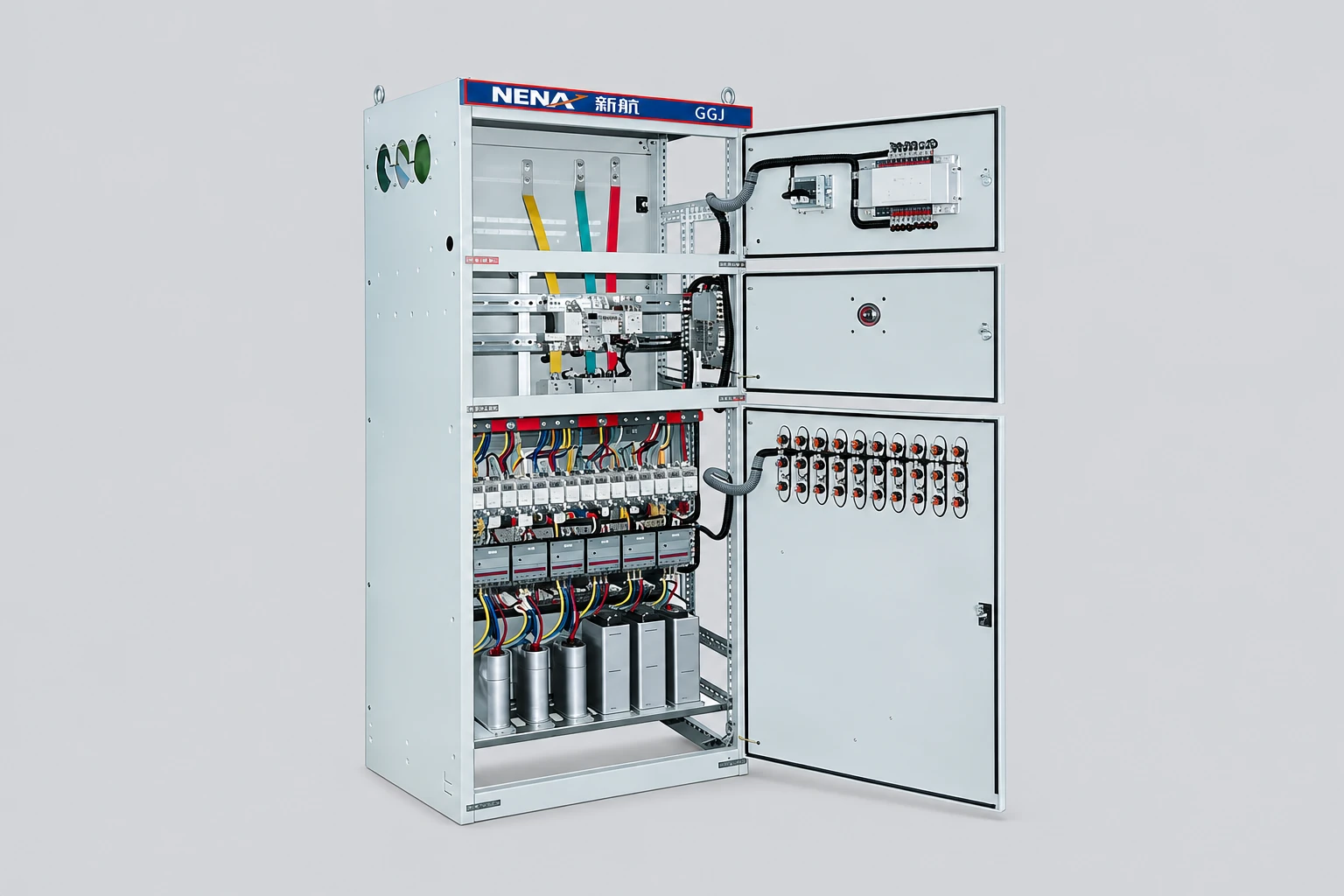
O Armário de compensação NENA GGJ provides a relevant product context. Its reference image shows a multi-compartment assembly with switching components and capacitors. An image cannot establish the installed fuse arrangement, switching technology or a replacement rating. Obtain the drawings and bill of materials for the supplied unit; do not identify an internal protective device from a similar-looking cabinet photograph.
Ask when the operation was first observed and what the bank was doing. Was the stage connecting, already carrying current, or returning after a supply interruption? Was another stage switching? Had anyone recently changed a capacitor, fuse, contactor or controller setting? Separate a witnessed event from a fault discovered during a routine inspection. The latter may have occurred much earlier than the alarm review suggests.
Keep the original controller history, protection indication and available power-quality records. Give all records a common time reference and identify any clock mismatch. A maintenance note saying “fuse blew after new drive installed” is a useful lead, but timing alone does not prove a harmonic cause. Document the change and ask what evidence would confirm or reject the proposed explanation.
Do not discard the operated fuse or damaged holder before the investigation team decides what needs examination. Label retained parts with the circuit identity and removal date. If a part is unsafe to retain, preserve the permitted photographs and disposal record. This maintains a connection between the physical observation and the eventual repair decision.
Capacitors can retain electrical energy after a supply is disconnected. A controller OFF command and an open contactor do not establish a safe work boundary. The responsible electrical team must identify sources, isolate and secure them, address stored energy, and verify the condition required for the planned work. Use the exact assembly instructions and the site’s authorized procedure, including any equipment-specific discharge and earthing requirements.
HSE’s Electricity at work guidance describes planning, competence and precautions for electrical work. It is a useful basis for assigning responsibility, rather than a substitute for the cabinet manual. This article deliberately gives no waiting period: a generic time copied from another bank cannot prove that this assembly is safe to touch.
The following table is a suggested investigation framework, not a diagnostic verdict. It builds on the component checks discussed in Fluke’s capacitor troubleshooting guidance. That guidance identifies capacitor, reactor and connection problems among possible causes. A reactor check applies only where the actual stage includes a reactor; the GGJ product photograph is not evidence of a detuned arrangement.
| Observation | Evidence to preserve | Question for the responsible engineer |
|---|---|---|
| One stage is unavailable | Drawing, stage command, actual component condition and phase identity | Is the open fuse the primary fault or the result of another failed component? |
| Damage is concentrated at a holder | Contact condition, discoloration, part identity and installation record | Did the connection or holder contribute to local heating? |
| Operation coincides with switching | Event timeline, stage sequence and available transient record | Does the switching duty match the approved component combination? |
| Several stages have problems | Supply history, load changes and stage-by-stage findings | Is there a shared supply, environmental or design issue? |
| Failure recurs after replacement | Previous and replacement fuse specifications and repair findings | Was the cause resolved, and was the replacement actually approved? |
An open fuse describes an interrupted circuit; it does not, by itself, classify the capacitor. Conversely, an apparently intact fuse does not prove that every capacitor is healthy. Ask the maintenance specialist to assess the relevant components using the manufacturer’s permitted methods. Record the method, equipment identity, conditions, results and acceptance basis. Avoid a conclusion consisting only of “checked OK” without identifying what was checked.
Visible swelling, leakage or heat damage needs a documented disposition. The absence of those signs is not a complete electrical assessment. Where a bank has several similar stages, preserve their individual identities rather than moving parts between stages as an informal experiment. Moving components can obscure the original failure pattern and create uncertainty about the final configuration.
For a bank that still appears to compensate but has unequal phase readings, use the separate capacitor bank current imbalance guide. That discussion addresses measurement and operating-state interpretation. Here the decision is whether the affected circuit has an understood failure mechanism and an approved route back to service.
cURL Too many subrequests by single Worker invocation. To configure this limit, refer to https://developers.cloudflare.com/workers/wrangler/configuration/#limits.
cURL Too many subrequests by single Worker invocation. To configure this limit, refer to https://developers.cloudflare.com/workers/wrangler/configuration/#limits cURL Too many subrequests by single Worker invocation. To configure this limit, refer to https://developers.cloudflare.com/workers/wrangler/configuration/#limits cURL Too many subrequests by single Worker invocation. To configure this limit, refer to https://developers.cloudflare.com/workers/wrangler/configuration/#limits.
cURL Too many subrequests by single Worker invocation. To configure this limit, refer to https://developers.cloudflare.com/workers/wrangler/configuration/#limits.
cURL Too many subrequests by single Worker invocation. To configure this limit, refer to https://developers.cloudflare.com/workers/wrangler/configuration/#limits.
cURL Too many subrequests by single Worker invocation. To configure this limit, refer to https://developers.cloudflare.com/workers/wrangler/configuration/#limits.
Agree what the repair must demonstrate before work starts. The record should connect the identified cause, corrective action, installed parts, inspection or test results, final settings and authorization to resume operation. Where the cause remains uncertain, describe the remaining uncertainty and the decision owner. Do not silently convert an unresolved investigation into an accepted repair because a new fuse is available.
Any monitored return to service must follow the authorized commissioning plan. Define the expected observations, the conditions that require stopping, and who reviews the results. Keep the observation period appropriate to the suspected event: a successful first connection does not test every stage combination or later operating condition. This is particularly relevant when the original failure was intermittent rather than immediate.
For procurement planning, the bank’s overall capacity and stage schedule belong with the power-factor correction panel sizing record. Restoring a failed circuit does not establish that the bank’s original sizing remains suitable after a plant expansion. Keep those two decisions visible so a replacement request does not become an undocumented redesign.
The IIT Roorkee lecture below explains power-factor improvement using capacitors. It supports the distinction between compensation performance and component protection. It does not demonstrate refusing this cabinet or authorize maintenance access.
Watch on YouTube — IIT Roorkee July 2018
Do not increase the rating without approval for the actual protected circuit. Investigate the operation and confirm the replacement specification against the assembly design.
No. Preserve the circuit evidence and assess the relevant components and connections using approved methods. The fuse condition alone does not identify the initiating cause.
No. An aggregate reading does not establish the condition of each stage or validate the repair. Use the defined inspection, test and return-to-service evidence.
Send the assembly identity, circuit drawing, original fuse and holder information, event history, observed damage and the responsible engineer's approved replacement requirements.