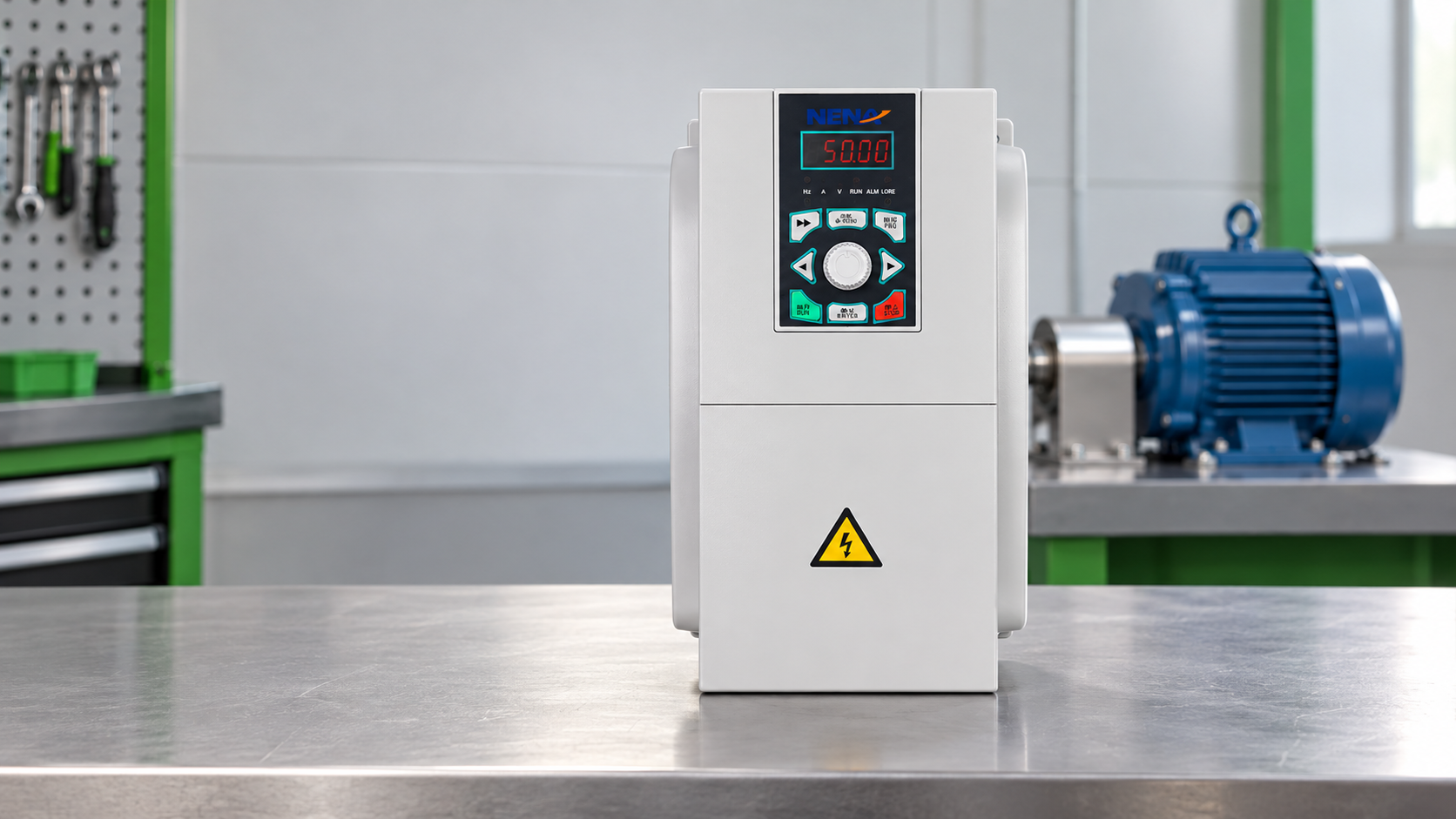
How a soft starter manages compressor inrush
Hermetic compressors draw locked-rotor current (LRA) for a short interval while the rotor accelerates. DOL contactors apply the full sine wave immediately, so a motor marked 20 A running current can briefly demand several times that value. The result may be a brownout, nuisance trip, audible contactor chatter, or stalled restart when head pressure is high.
A soft starter ac (the product category is often written as soft starter ac) uses back-to-back thyristors or similar power semiconductors to control each half cycle. An aircon soft starter applies the same principle to a fixed-speed AC compressor, raising the firing angle over an adjustable ramp before closing a bypass path after the motor reaches speed. Current limiting, initial-voltage settings, and kick-start options are tuned to the compressor and ambient conditions; they are not universal presets.
Commissioning should include an oscilloscope or true-RMS clamp-meter trace where available, plus a start test at the lowest expected supply voltage. IEC 60947-4-2 defines functional and performance requirements for AC semiconductor motor controllers and starters; it does not tell you what ramp value a particular compressor needs. Record peak current, start time, line voltage, and restart interval so a future technician can distinguish a control issue from a refrigerant or pressure problem when servicing an aircon soft starter.
Soft start for RV AC compressors: generator and campground realities
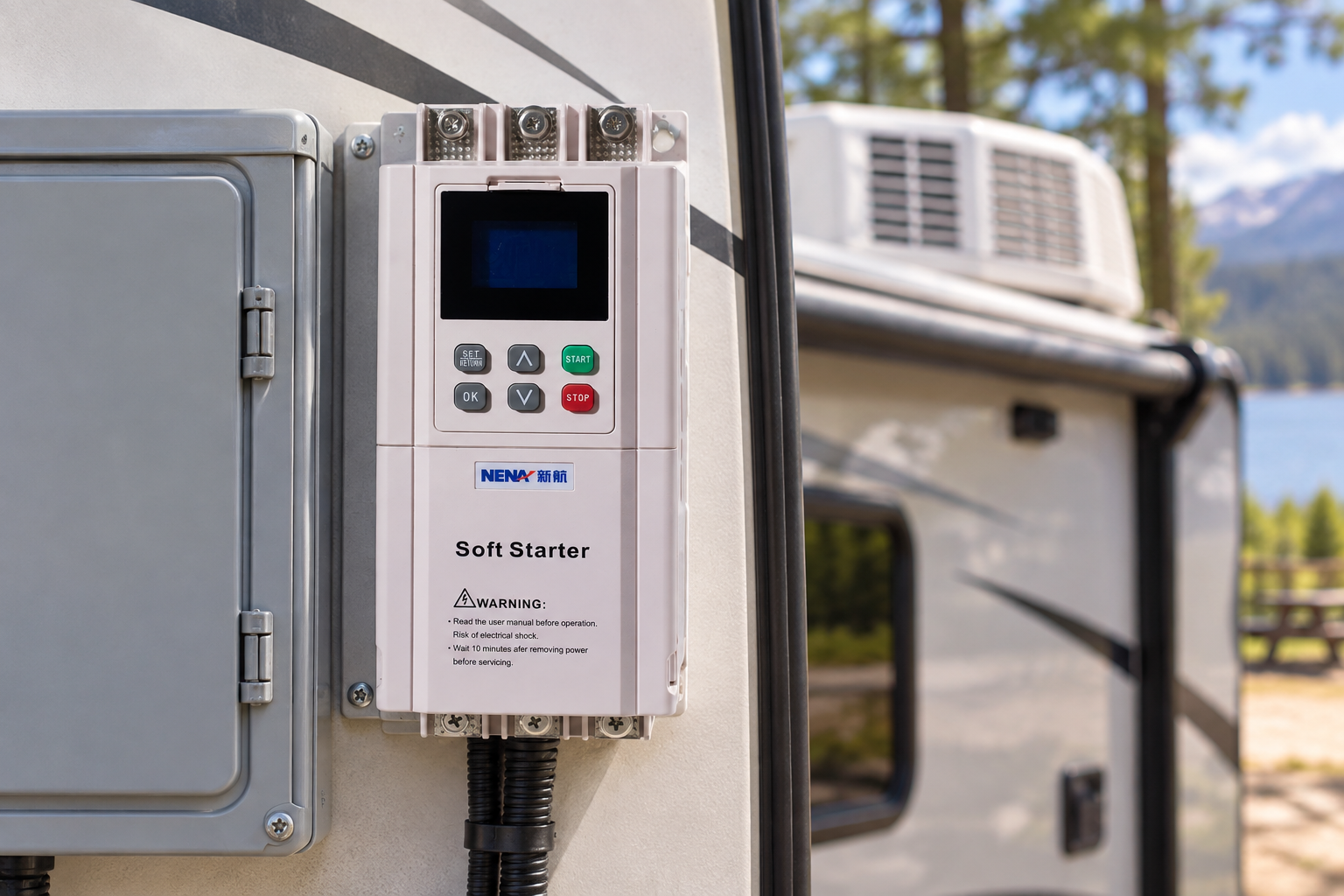
Rooftop RV air conditioners are usually single-phase units with a capacitor-run compressor and a fan. A properly selected soft start for rv ac reduces the step change in current, helping an inverter generator maintain frequency and voltage when the compressor starts. It also helps when a microwave, battery charger, or refrigerator is already sharing the circuit.
Do not treat a soft start for RV AC as a wattage multiplier. Generator continuous rating, surge rating, altitude derating, extension-cord length, and campsite voltage still govern the safe load. An illustrative calculation: if a compressor has 60 A LRA and a starter limits the observed peak to 30 A for 0.4 seconds, the instantaneous demand is lower, but the generator must still supply the normal running load and any other connected appliances. The figures are examples only; use measured data from the exact model.
Install the device inside the manufacturer-approved compartment, keep control wiring away from high-temperature surfaces, and check that the run capacitor and start components meet the air-conditioner maker’s instructions. A service disconnect and overcurrent protection remain mandatory. For a practical product-category overview, see the soft starter range.
Soft starter versus VFD for AC compressors
Both technologies moderate starting current, but they solve different problems. A soft starter ac keeps the motor at line frequency and acts mainly during acceleration and stop. A variable-frequency drive (VFD) creates a variable-frequency, variable-voltage waveform so the motor can run continuously at reduced speed. Unlike a soft starter, a VFD may operate below the 50/60 Hz line frequency; review IEC 61800-3 EMC requirements and the compressor maker’s operating map before applying one. Most fixed-speed comfort-cooling compressors are not approved for VFD operation without explicit manufacturer guidance, oil-management provisions, and electromagnetic-compatibility review.
Choose a soft starter ac when the objective is a gentler start, fewer voltage dips, or generator compatibility on a fixed-speed unit. An aircon soft starter is usually the simpler retrofit when the compressor must remain at line frequency. Choose a VFD when the compressor and controls are designed for speed modulation and the project needs capacity control or energy optimization at part load. A VFD generally needs line-side protection, motor-side filtering or reactor consideration, parameter commissioning, and a plan for harmonics; a soft starter typically has a simpler retrofit path but provides little running-efficiency gain after bypass.
The honest comparison is at system level: calculate annual run hours, cycling frequency, demand charges, service access, and replacement cost. A starter that prevents one nuisance shutdown may deliver more value than a drive whose variable-speed features cannot be used by the selected compressor.
Performance and compatibility comparison
| Dimension | Direct-on-line starter | Soft starter ac | VFD |
|---|---|---|---|
| Starting profile | Full voltage; highest inrush | Adjustable voltage ramp and current limit | Controlled frequency and voltage ramp |
| Running speed | Fixed at line frequency | Fixed after bypass | Variable when motor/compressor is approved |
| Generator impact | Largest voltage and frequency step | Lower step; verify generator stability | Low starting current, but switching harmonics require review |
| Mechanical stress | Highest torque shock | Reduced acceleration shock | Precisely managed torque |
| Retrofit complexity | Lowest initial complexity | Moderate; bypass and heat clearance matter | Highest; parameters, EMC, and motor suitability matter |
| Typical TCO logic | Low equipment cost, possible nuisance trips | Moderate cost aimed at reliable starts | Higher cost justified by usable part-load control |
Application sizing by AC compressor system
| Application | Primary risk | What to verify before specifying | Useful evidence |
|---|---|---|---|
| RV rooftop AC | Generator overload or campground voltage sag | Compressor LRA, generator continuous/surge rating, cable length, ambient temperature | Measured start trace with all normal RV loads connected |
| Residential split or packaged AC | Breaker trips and light flicker on long feeders | Single/three-phase supply, contactor layout, manufacturer approval, enclosure heat dissipation | Voltage at the compressor terminals during start |
| Commercial rooftop or condensing unit | Process interruption and repeated high-head restarts | Duty cycle, bypass current rating, restart delay, service-bypass procedure, coordination study | Trend logs and protection settings reviewed by a qualified engineer |
For installations needing a built-in bypass, compare the NR1000 series. Where maintenance isolation or panel architecture calls for an external path, the PR800 series provides a separate reference point. These pages describe product families; final ratings must come from the selected datasheet and motor nameplate.
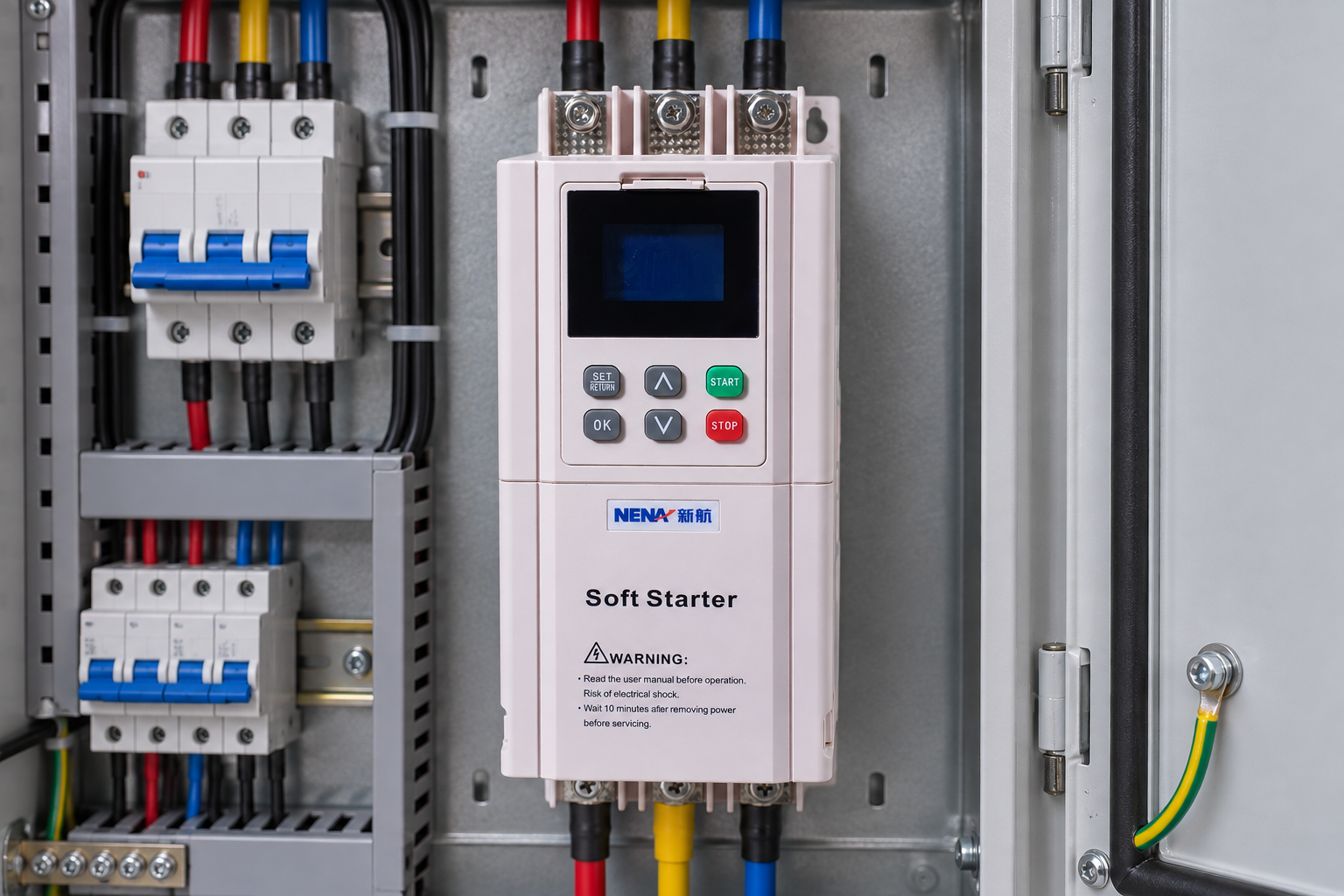
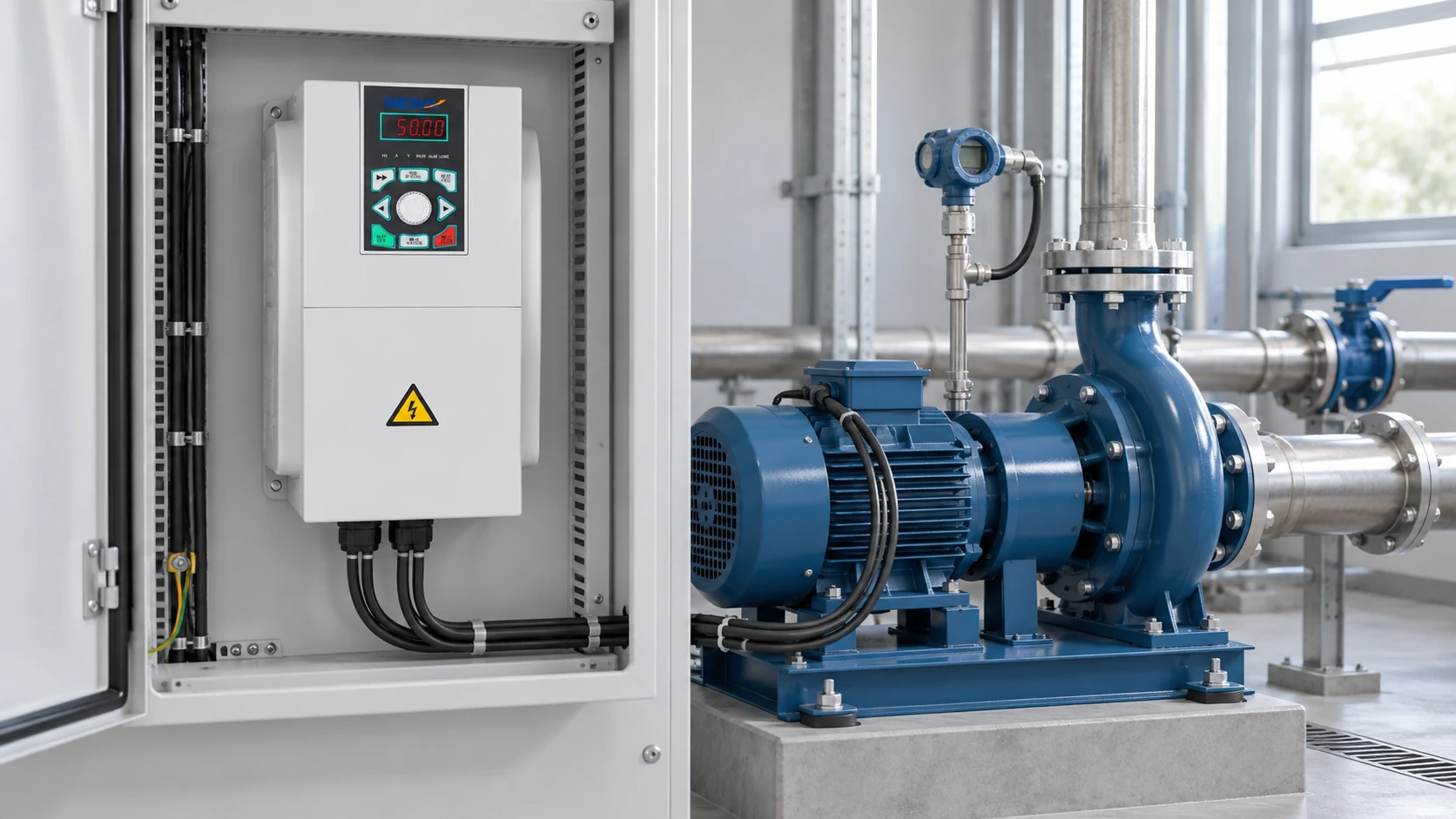
Panel view: leave clearance for heat dissipation and safe service access.
Standards, testing, and compliance boundaries
IEC 60947-4-2 covers AC semiconductor motor controllers and starters, including tests for temperature rise, dielectric properties, endurance, and performance under specified conditions. It is a product standard, not a blanket approval for every installation. In North American projects, UL 508 addresses industrial control equipment, while UL 60947-4-2 is the newer harmonized path for semiconductor motor controllers and starters where its scope and edition apply.
Ask the supplier which edition, markings, and conditions of acceptability apply to the exact catalog number. Listing a standard on a quotation is not the same as claiming a certification; marketing language should match the certificate or evaluation report. The installation still requires correctly sized conductors, overcurrent protection, grounding, disconnects, and local electrical-code compliance. See ZR900 online soft starters only after confirming that its topology fits the control scheme.
Selection guide and sourcing questions
- Capture motor voltage, phase, rated current, LRA, compressor type, and the manufacturer’s permitted starting method.
- Define the electrical objective: lower peak current, less torque shock, fewer restarts, or generator compatibility. Do not use a current target without a test condition.
- Check bypass duty, enclosure IP/NEMA needs, ambient-temperature derating, wiring length, and service clearances.
- Request a test plan covering cold start, hot restart, low-line voltage, and simultaneous loads; keep the results with the commissioning record.
- Confirm documentation and compliance scope for the destination market. NENA (Zhejiang Xinhang Electric) can be considered at this stage when configurable soft-starter products, drawings, and application support are required.
Frequently asked questions
What is an AC soft starter?
This device is a solid-state controller that gradually applies voltage to an AC motor, then commonly uses a bypass contactor after acceleration. It reduces the severity of inrush and torque shock but does not provide variable-speed operation. Setpoints must follow the compressor maker’s limits.
What is an RV AC soft starter?
An RV AC soft starter is a compact starter matched to a recreational-vehicle rooftop air-conditioner compressor. It is installed in the unit or its supply circuit to make starts less abrupt for a portable or onboard generator. Confirm enclosure temperature, capacitor wiring, and service-disconnect requirements before installation.
How much can an RV AC soft starter reduce startup current?
There is no single guaranteed percentage. A soft start for rv ac may substantially lower the measured peak compared with DOL, but the result depends on compressor design, line voltage, ramp settings, and measurement bandwidth. Use the exact unit’s LRA and a true-RMS or peak-capable instrument to document the reduction.
Can a soft starter let an RV AC run on a smaller generator?
Sometimes, if the generator previously failed only during the short starting surge and still has enough continuous watts for the running load. A soft start for RV AC cannot overcome a generator that is undersized for continuous demand, altitude, heat, or other appliances. Test with the refrigerator, charger, and typical loads operating.
Is a soft starter the same as a VFD?
No. A soft starter ac controls acceleration at line frequency, while a VFD controls frequency and can regulate speed. Use a VFD only when the compressor and system controls are explicitly designed for it.
References
- IEC 60947-4-2: AC semiconductor motor controllers and starters, International Electrotechnical Commission.
- UL 508, Industrial Control Equipment, UL Standards & Engagement.
- UL 60947-4-2, Low-voltage switchgear and controlgear—AC semiconductor motor controllers and starters, UL Standards & Engagement.
Reliable starts come from matching the motor, supply, controls, and compliance evidence—not from a label alone. If you are comparing an ac soft starter for an RV, residential, or commercial AC project, review the measured start data with NENA/Zhejiang Xinhang Electric and contact the technical team for a documented selection.