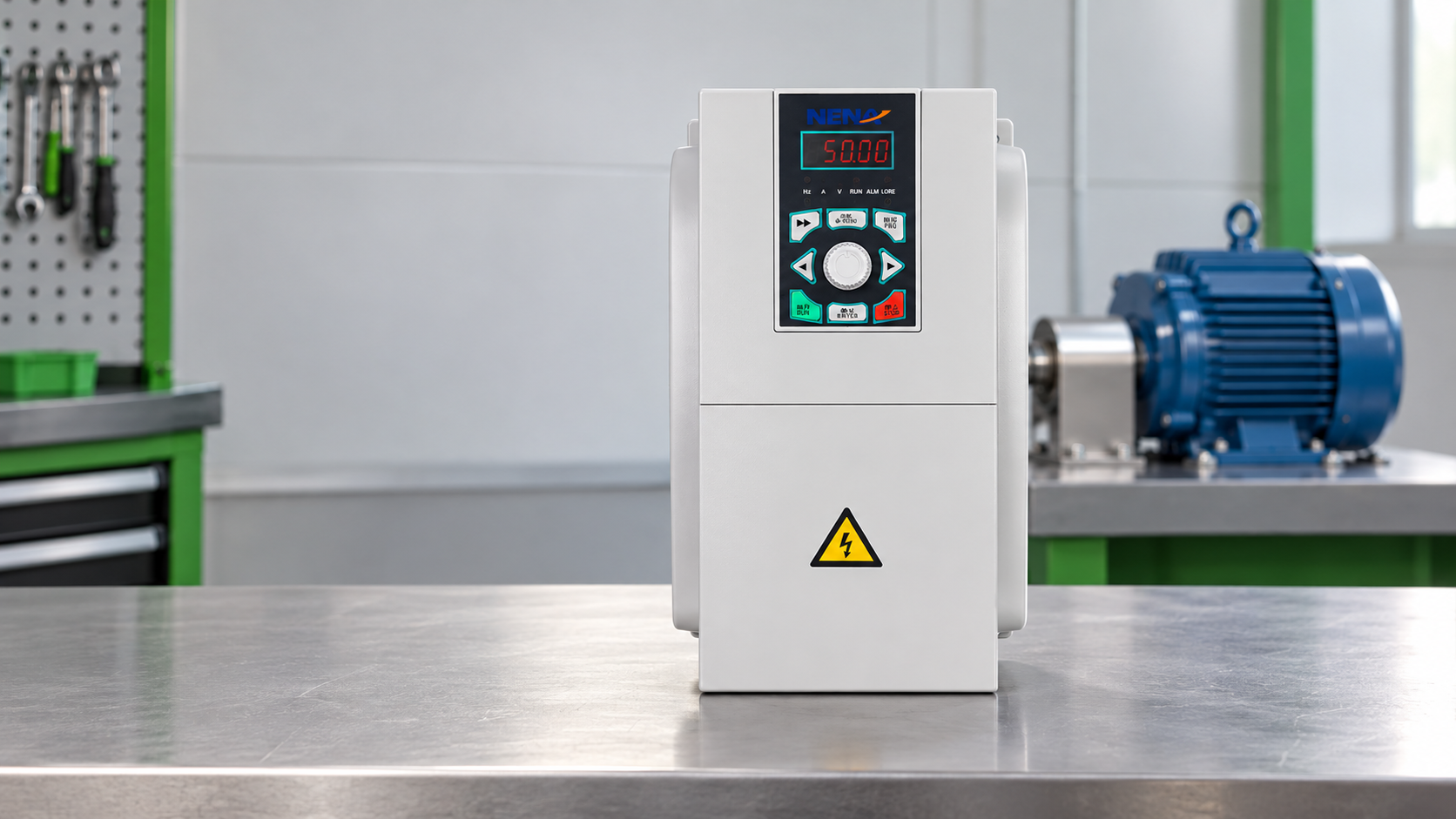
When Mei Lin, a maintenance engineer in Ningbo, encountered a loaded packaging conveyor that stalled after a drive replacement, she restarted it; the belt lurched, the motor tripped on overcurrent within seconds, and production stopped. The supplier initially blamed a bad unit; a review of the nameplate and duty cycle reversed that conclusion: the selected drive was rated for the motor’s voltage, but its acceleration, torque and braking requirements had never been specified.
Summary: A VFD is an inverter-based motor drive, but “inverter” alone can also mean a device that converts DC to AC without controlling a motor. Check three data groups—motor nameplate, load duty and braking needs—before choosing. IEC 61800 is a family of drive standards, not a universal certification mark; ask for the exact conformity evidence for the intended market.
In industrial purchasing, a VFD (variable-frequency drive) normally rectifies incoming AC to a DC link and then inverts it into a controlled AC waveform. By changing output frequency and voltage, it regulates induction- or permanent-magnet-motor speed and can manage acceleration, stopping and torque. That is why many suppliers use “VFD” and “inverter” interchangeably in product names.
The distinction matters in a specification. A standalone inverter may simply change DC to AC for a load; a motor VFD adds feedback, ramp settings, protection and control logic. A VFD inverter therefore should be evaluated as a motor-control system, not as a generic power-conversion box. Review input phase and voltage, motor current, overload rating, control mode, enclosure, ambient temperature and the required ramp or braking method. For an initial review, compare at least two operating points—normal running and the hardest start—against the applicable IEC 61800 requirements and the supplier’s test evidence.
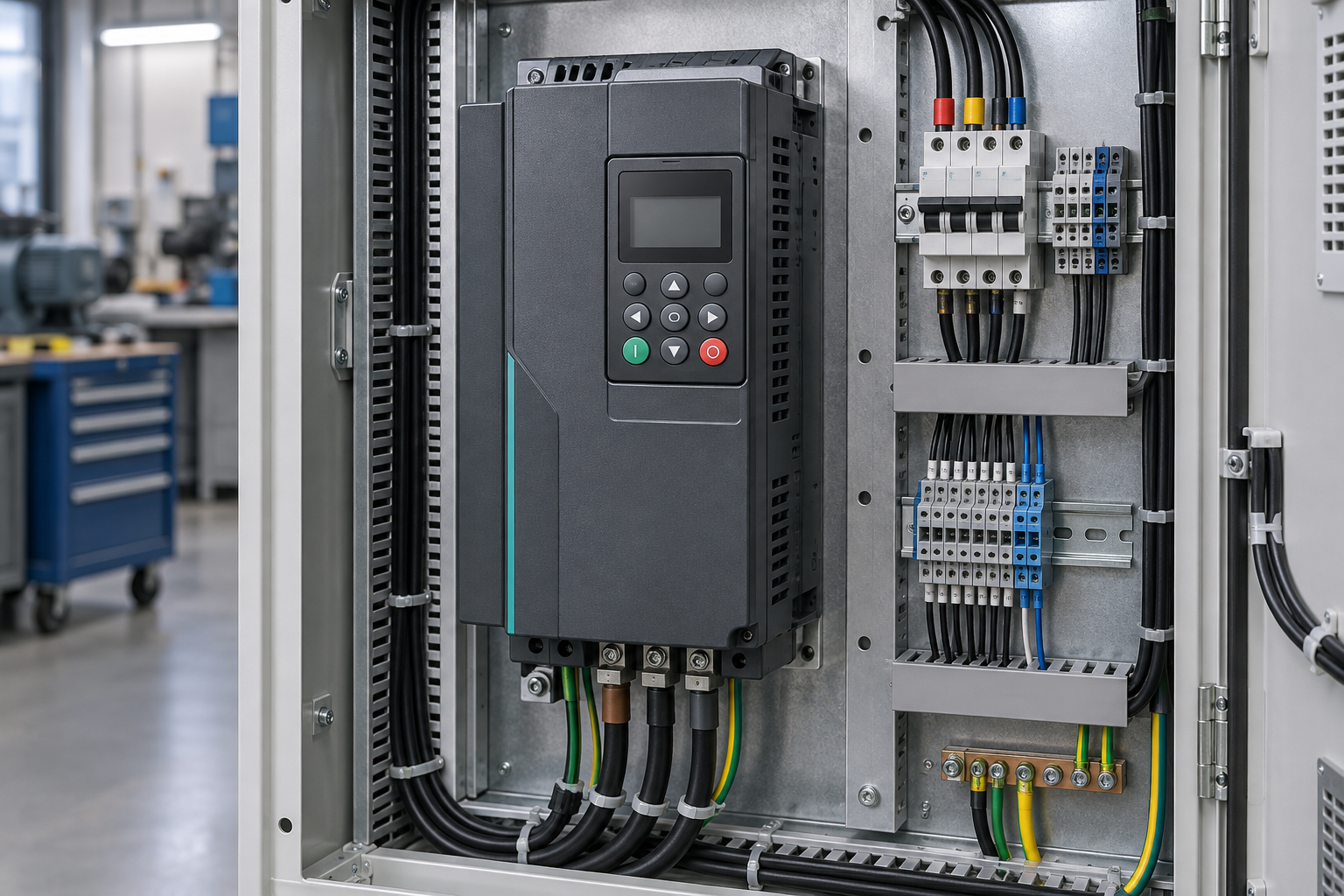
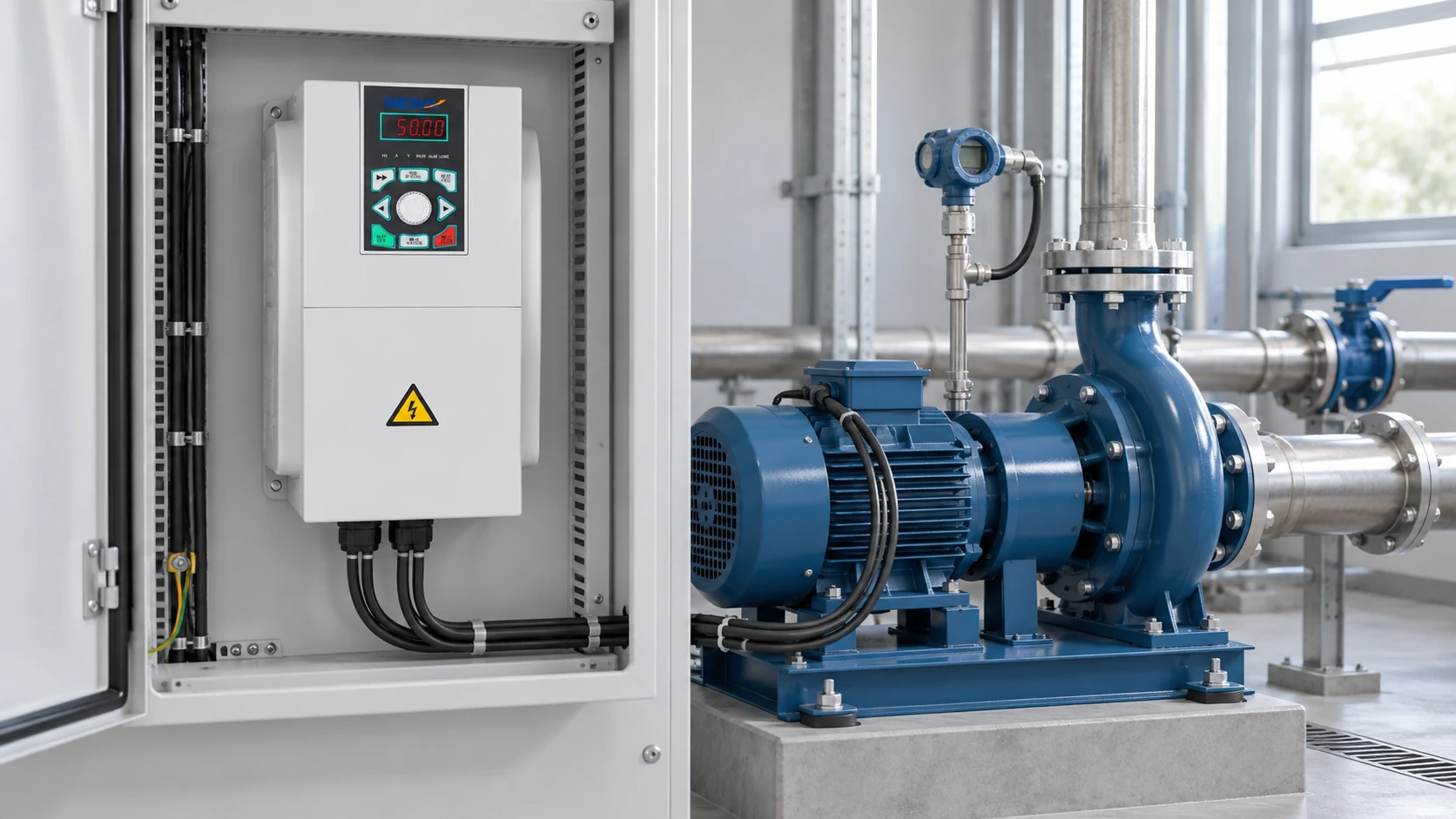
A drive-panel view helps reviewers confirm wiring, ventilation and isolation provisions.
Conveyor duty is governed by torque and acceleration as much as by running speed. A belt can need substantially more torque at a loaded start than at steady state; incline, belt tension, gearbox ratio, jam risk and stopping time all change the selection. A VFD for conveyor should be checked with a controlled loaded-start test, recording current, acceleration time in seconds, fault history and belt behavior rather than relying on an unloaded bench run.
| Selection dimension | Motor VFD | Soft starter | Fixed-speed starter |
|---|---|---|---|
| Speed control | Continuous frequency and speed control | Normally ramped start and stop only | No operating-speed control |
| Starting behavior | Adjustable ramp and torque strategy | Reduces electrical and mechanical shock | Highest inrush and shock risk |
| Conveyor fit | Useful when speed, loaded starts or stopping must be managed | Useful when speed is fixed and the start is moderate | Suitable only where the load and process tolerate a direct start |
| Main caveat | Requires correct motor, duty and parameter setup | Cannot provide normal variable-speed control | May need larger upstream equipment and mechanical safeguards |
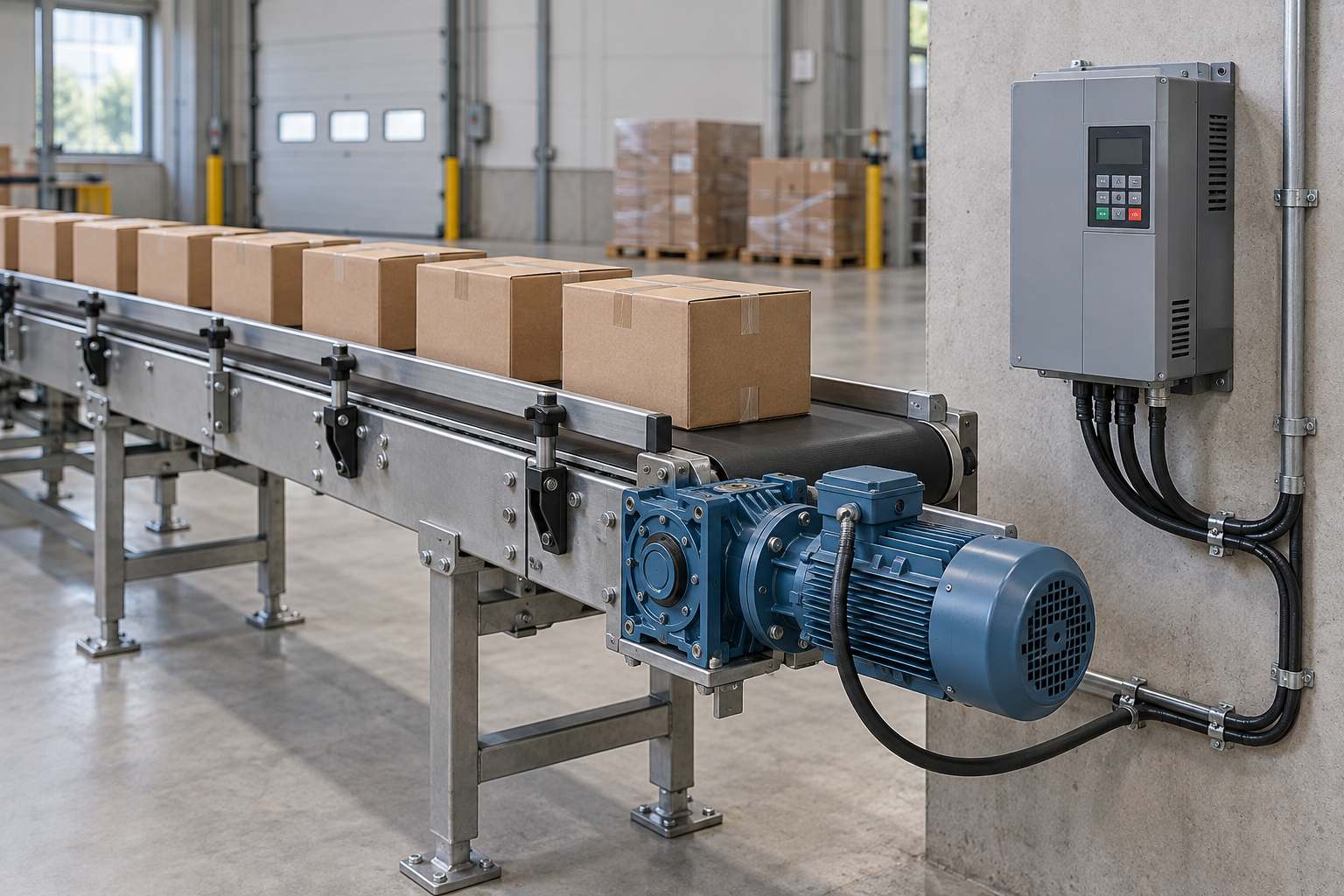
Conveyor duty should be checked at the loaded start, not only at running speed.
For a project that needs more than a drive selection, compare the process requirements with this VFD for conveyor belt system solution. The drive is only one part of a safe system: guards, emergency stops, braking and lockout procedures remain essential.
A 3 phase VFD must match the motor’s rated voltage, current, frequency and connection—not just its kilowatt number. Confirm whether the supply is three-phase, whether the motor can be connected for the drive output, and whether the application needs sensorless vector control, external feedback or a braking resistor. A practical commissioning record should include at least four nameplate fields, minimum and maximum frequency, acceleration and deceleration times, and the measured current under a representative-load test.
The motor and drive should also be treated as an electrical system. Cable length, earthing, electromagnetic compatibility, heat dissipation and motor insulation can affect reliability. Where stopping energy is significant, calculate the duty and braking method with the system designer; do not assume every drive can absorb regenerated energy internally.
Use this short procurement sequence:
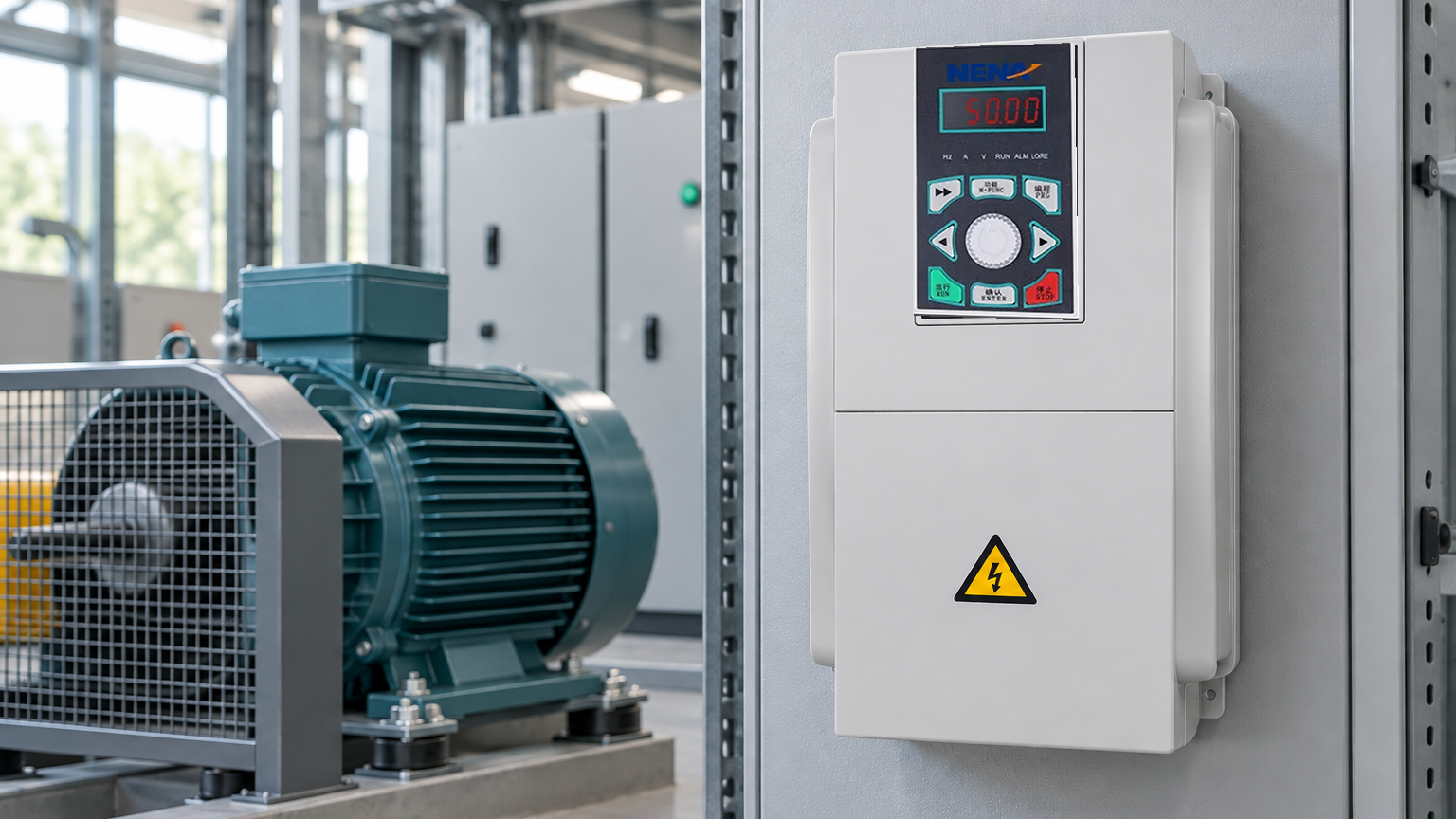
NENA/Zhejiang Xinhang Electrical publicly presents frequency converters and inverters alongside soft starters, control cabinets and distribution products. Public information for its NH820 general-purpose vector inverter lists 5.5, 7.5 and 11 kW ratings, three-phase 380 V input and applications such as industrial water pumps, boiler induced-draft fans, wire drawing, textile equipment, medium CNC and plastic blow molding. Those are useful starting points, not a substitute for motor and duty data; review the NH820 general-purpose inverter information against the project schedule and required evidence.
IEC 61800 is a standards family covering adjustable-speed electrical power drive systems, including performance, EMC and safety topics across different parts. It is not a single blanket claim that every drive is certified to every requirement. Ask which part, edition, test report or declaration applies, and match it to the destination market and the claims used in the purchase specification.
The U.S. Department of Energy’s motor-systems guidance emphasizes system-level efficiency: motor, drive, transmission and process conditions should be considered together. OSHA’s control-of-hazardous-energy rules are relevant to servicing in covered workplaces; a stop command is not the same as verified isolation. Document the applicable local electrical, machinery and workplace-safety requirements before installation or export.
No. A motor VFD is the right tool when controlled motor speed, torque or ramps are required; it may be unsuitable for a battery backup, photovoltaic or sensitive electronic-load application that needs a clean standalone AC source. Confirm the load type, waveform, source, transfer behavior and protection requirements before treating the terms as synonyms.
Usually, yes, when the drive output, motor voltage, current and connection are compatible. Check the motor’s frequency, insulation, cooling and duty, then commission with conservative ramp and current settings; a high-inertia or frequent-start application may need a different overload or braking arrangement.
A conveyor VFD is a variable-frequency drive selected and configured to control a conveyor motor’s speed, torque and acceleration. Its suitability depends on belt tension, incline, loaded starts, stopping energy, gearbox and safety controls—not on the label alone.
Start with the motor’s rated voltage and full-load current, then check the application’s torque profile, overload duration, ambient conditions, switching frequency and braking needs. Choose by the required duty and current capability, not by horsepower or kilowatts alone, and validate the result with a loaded commissioning test.
Only for an appropriate motor-load application and within the drive’s specified input and output limits. A VFD is not automatically a general-purpose AC power source; verify waveform, grounding, neutral requirements, protection and the manufacturer’s permitted load types.
The honest answer is simple: a VFD uses inverter technology, but a safe selection starts with the motor and the work it must do. For a project-specific review, see the frequency converter options and contact Xinhang’s technical team with your nameplate, load and schedule data.