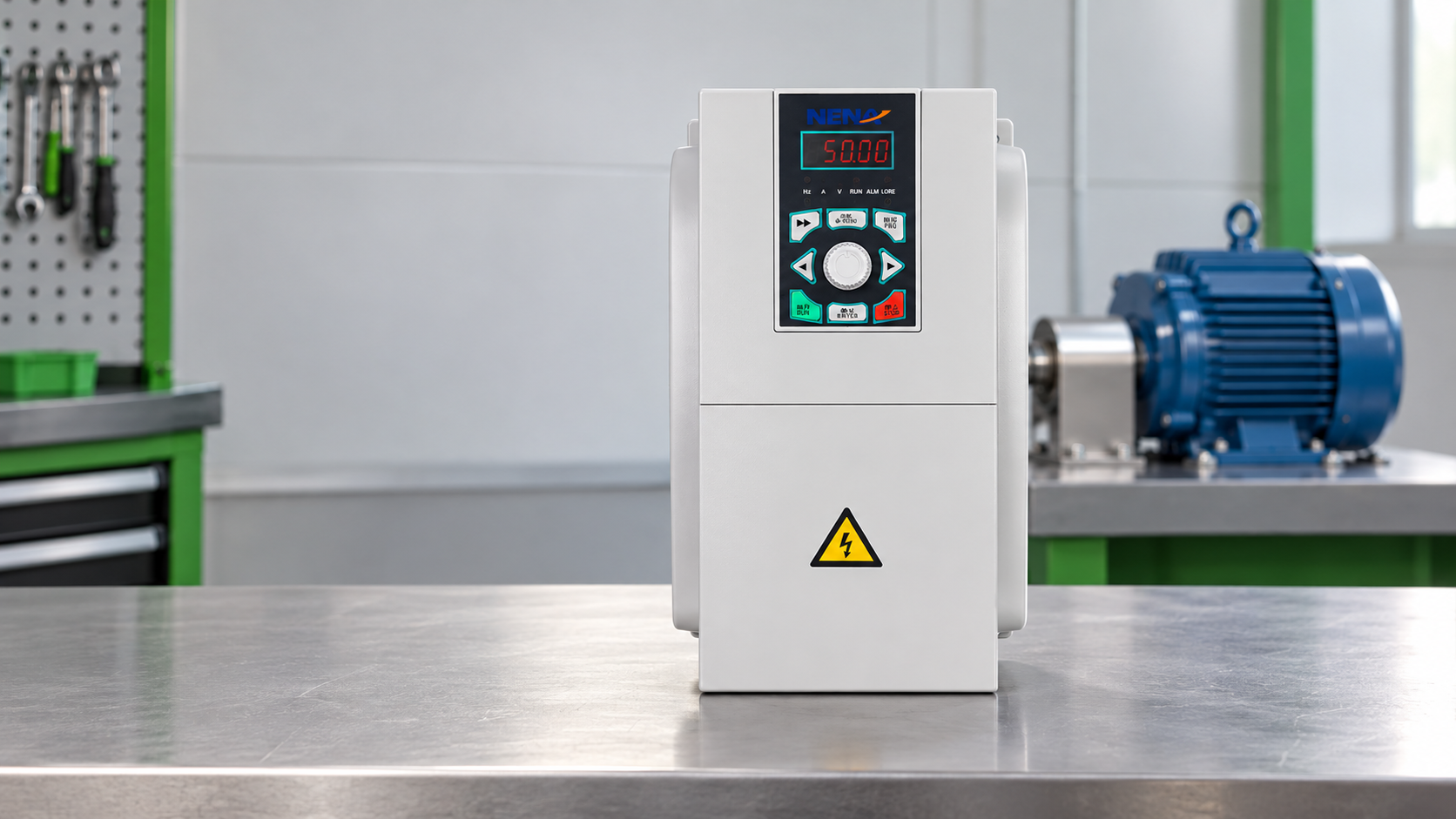
When Daniel Wu, a facilities engineer in Ningbo, restarted a 75 kW screw compressor after a weekend shutdown, the motor protection tripped before the receiver reached pressure. He reset the breaker; lights dipped, the generator sagged, and the compressor stopped again. The compressor was healthy. The failure came from selecting a starting method without reconciling locked-rotor current, generator impedance, unload-valve timing, and starts per hour.
Summary: A soft start for air compressor applications can moderate current rise and mechanical shock, but it is not automatically an energy-saving device. IEC 60947-4-2 covers semiconductor motor controllers and starters; installation, motor, compressor, and workplace requirements remain separate checks. A soft starter for air conditioner compressor duty must respect compressor type, pressure equalization, anti-short-cycle logic, and the OEM wiring diagram. Record nameplate data, locked-rotor current, starts/hour, generator capacity, and stopping requirements; then validate with a measured start.
The phrase soft start for air compressor describes a controlled-voltage or controlled-current starting method. Semiconductor devices increase the voltage applied to the motor over a programmed ramp, so the motor accelerates with less abrupt electrical demand than it would under direct-on-line (DOL) starting. A bypass contactor may then carry the running current after acceleration; whether bypass is appropriate depends on the starter design, duty cycle, harmonics, enclosure, and fault-clearing scheme.
The practical target is not a magical percentage reduction. A DOL motor can draw several times its rated current during acceleration, while a correctly configured soft starter can reduce the peak seen by the upstream source. The actual result depends on motor slip, compressor torque, suction and discharge pressure, cable impedance, transformer or generator stiffness, and ramp settings. IEC 60947-4-2 is a product standard for AC semiconductor motor controllers and starters, not a promise that every installation will start every compressor successfully.
For a first-pass engineering check, compare three measurements:
Use a true-RMS power-quality analyzer where waveform distortion or a generator is involved. Record at least three starts under representative pressure; do not infer performance from an unloaded bench start if the compressor normally starts against residual pressure.
The phrase soft starter for air conditioner compressor applies to a more constrained duty than many industrial motor starts. A reciprocating, scroll, screw, or rotary compressor may have different torque behavior, bypass requirements, internal protection, and allowable restart conditions. The starter must not defeat the compressor manufacturer’s crankcase-heater, pressure-switch, thermal, phase-loss, or anti-short-cycle protections.
Many HVAC controls impose a restart delay commonly in the range of 3–5 minutes, but the correct delay is the compressor and controller manufacturer’s requirement, not a universal soft-starter setting. For refrigerant compressors, use the OEM wiring diagram and applicable performance data such as ANSI/AHRI Standard 540 where relevant. Test starting at the highest expected head pressure and at the lowest permitted supply voltage; a smooth current trace at one operating point is not proof of compatibility.
An HVAC soft starter also needs a clear failure path. If a bypass contactor welds, a phase is lost, or the compressor remains locked, the system should trip safely and report the condition. Do not use a ramp to mask a mechanical seizure or refrigerant-side fault. The commissioning record should include supply voltage, phase sequence, ambient temperature, pressure state, start command timing, and protective-device response.
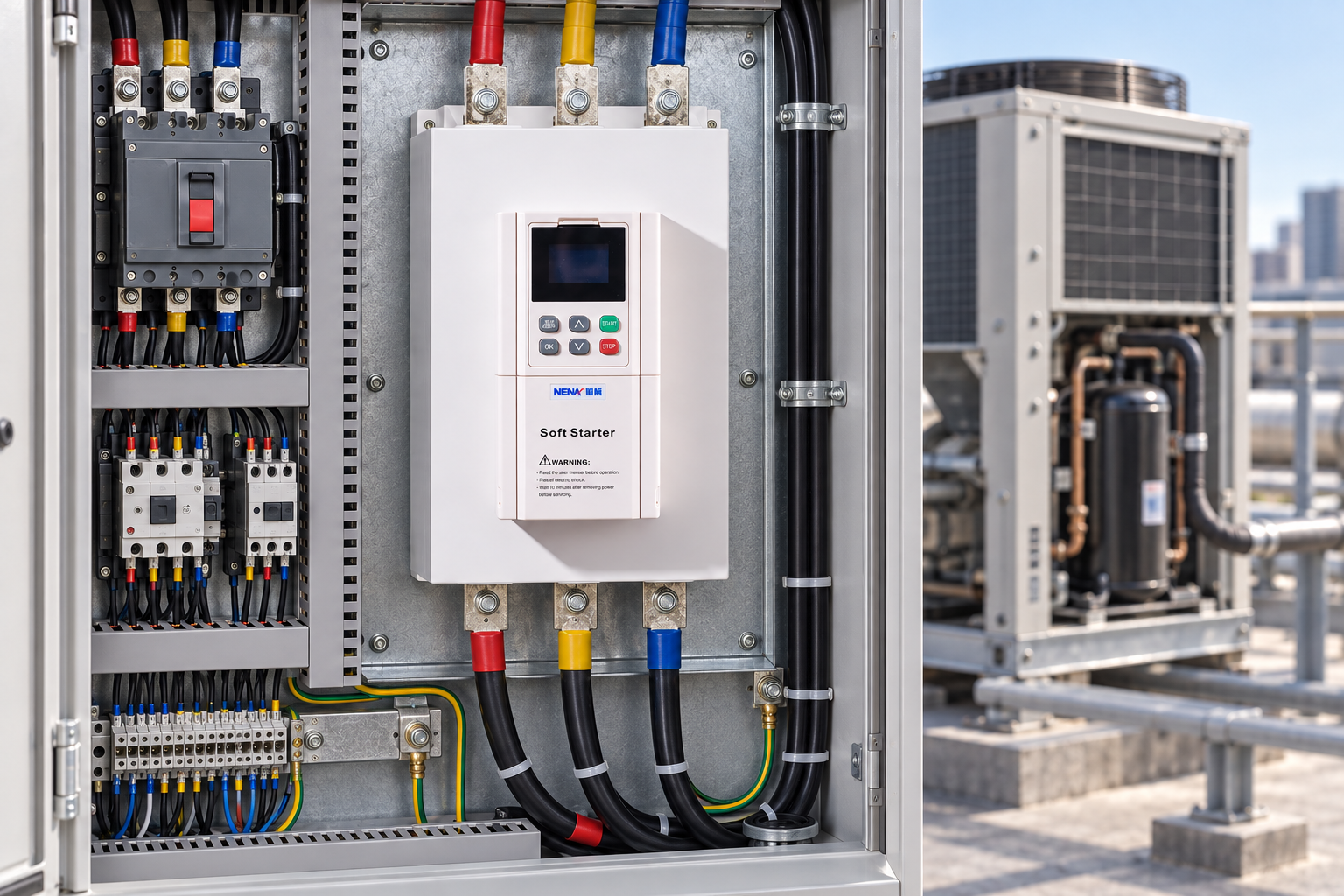
Verify compressor terminals, control interlocks, and restart timing against the OEM diagram before energizing the starter.
The commercial benefit is usually system stability rather than a guaranteed reduction in kWh. Lower starting demand can help a weak transformer or generator avoid nuisance trips, reduce visible voltage flicker, and limit torsional shock in couplings, belts, and compressor elements. It can also make a staged plant easier to operate when several motors share one feeder.
Consider this illustrative calculation, not a quotation or performance guarantee. A 75 kW, 400 V, three-phase motor operating at 0.86 power factor has a running current of approximately 126 A before efficiency and service-factor adjustments. If the source cannot tolerate a high inrush event, avoiding one failed start may protect production far more than a small change in running losses. Conversely, if a motor runs continuously at nearly full load, a soft starter that remains in the power path can add losses; a properly engineered bypass may improve the total-cost case.
| Starting method | Electrical behavior | Mechanical behavior | Compatibility and maintenance | TCO tendency |
|---|---|---|---|---|
| DOL starter | Highest inrush and feeder voltage dip risk | Abrupt torque; high stress at coupling and belt | Simple and widely understood; may need a stronger source | Lowest equipment cost, potentially higher disturbance and wear |
| Star-delta starter | Reduced starting voltage, with a transition event | Lower initial torque; transition can be harsh | Requires a suitable six-lead motor and careful timing | Moderate equipment cost; limited by load torque and transition quality |
| Soft starter | Adjustable voltage/current ramp; actual peak depends on settings and source | Controlled acceleration and optional controlled stop | Needs correct motor data, bypass, protection, and commissioning | Moderate equipment cost; value improves when starts or source capacity are constrained |
| Variable-frequency drive | Controls frequency and voltage; can provide low-speed torque | Broad acceleration control and process-speed control | Adds harmonics, EMC, programming, and maintenance considerations | Highest functional scope; can justify cost when speed control saves energy |
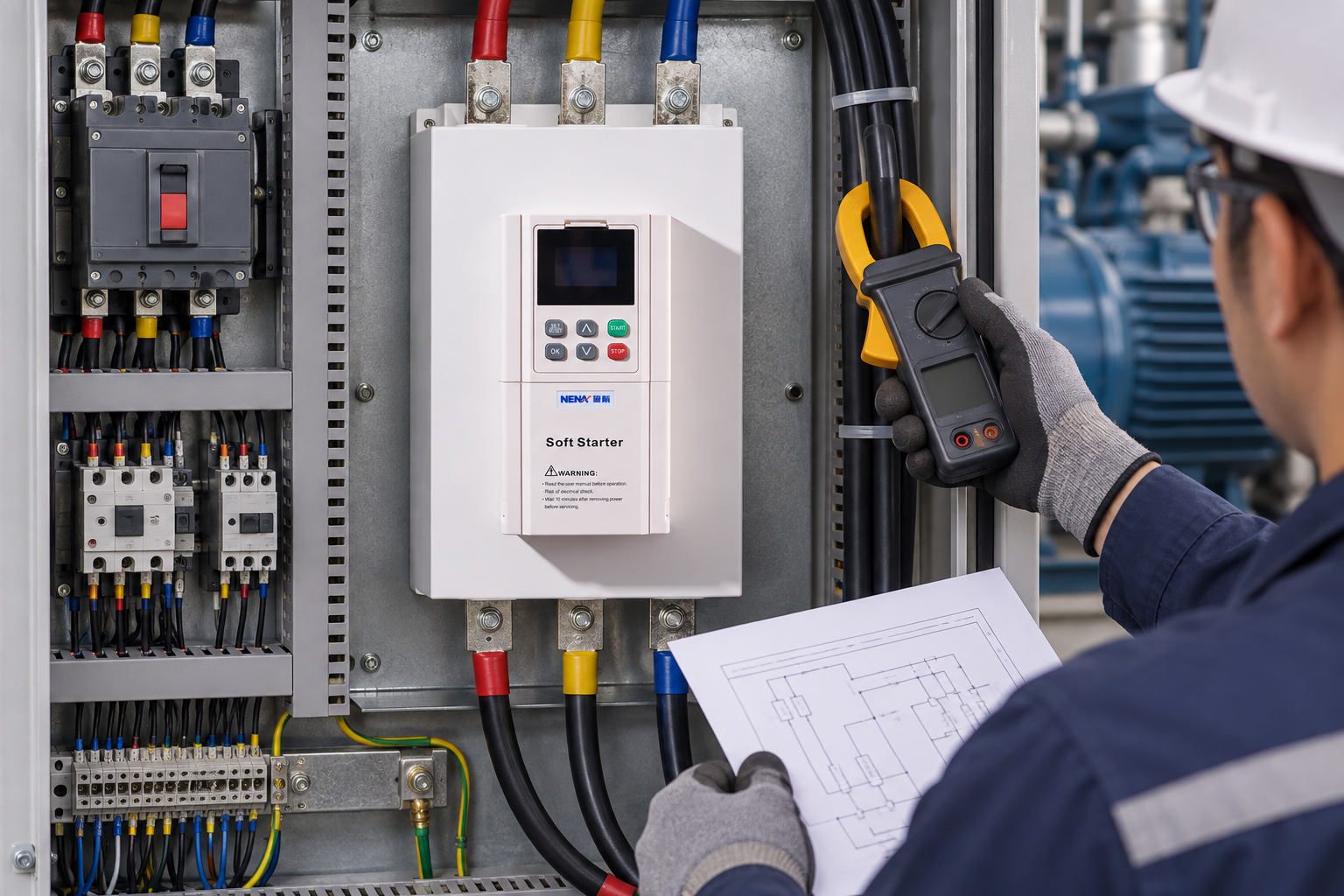
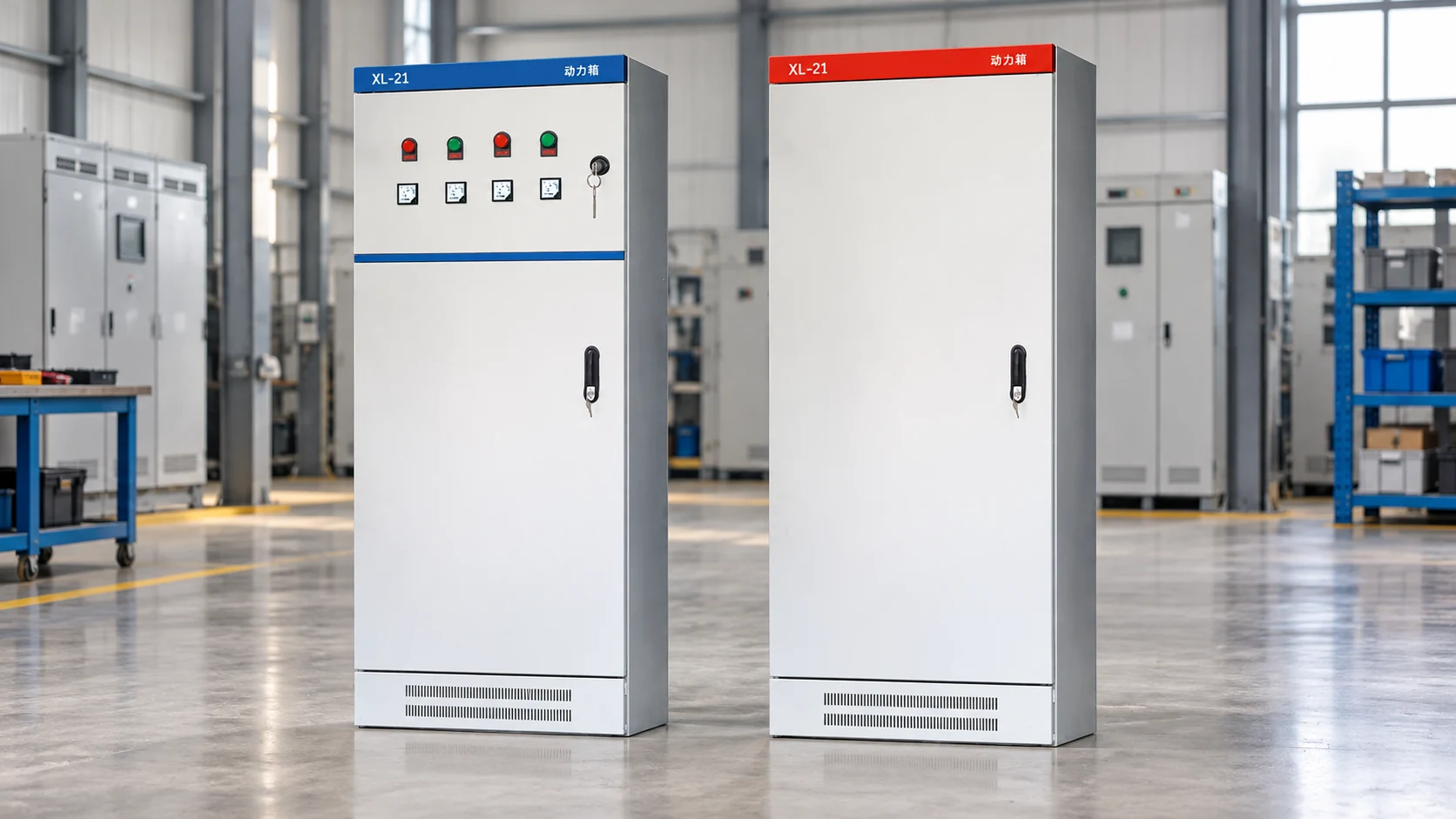
A representative soft-starter panel; verify its power path, bypass contactor, cooling, and service clearances against the approved design.
For a defensible ROI, measure the cost of failed starts, production interruptions, protective-device trips, coupling or belt replacement, and generator oversizing. Separate starting-event benefits from running-energy benefits, and state all assumptions. IEC 60034-2-1 test methods can support motor-loss comparisons, but a product test does not replace an installed-system measurement.
Selection becomes clearer when the application is expressed as a set of dimensions rather than a single horsepower value. The table below is a procurement screen; final settings require the motor and compressor documentation.
| Application dimension | What to record | Why it changes selection | Useful verification |
|---|---|---|---|
| Motor and compressor type | Induction motor, scroll, reciprocating, screw, or other; rated kW/HP and voltage | Torque curve, allowable starts, and bypass behavior differ | Compare nameplate and OEM data; confirm against NEMA MG 1 motor information |
| Source strength | Transformer or generator kVA, short-circuit strength, feeder length, and voltage tolerance | A weak source is more sensitive to current and voltage dip | Capture voltage and current with a true-RMS analyzer during three starts |
| Start condition | Unloaded, loaded, residual pressure, ambient and refrigerant state | Required torque and acceleration time can change materially | Commission at the worst credible operating condition |
| Duty and thermal capacity | Starts/hour, cycle duration, ambient, enclosure, and bypass arrangement | Semiconductor and bypass thermal limits are duty-dependent | Check IEC 60947-4-2 ratings and the manufacturer’s derating curve |
| Controls and protection | E-stop, overload, phase loss, pressure switches, anti-short-cycle timer | Incorrect interlocks can create unsafe restart or nuisance trips | Functional test every trip and restart path; document results |
| Service environment | Dust, moisture, altitude, access, and local electrical rules | Enclosure, cooling, clearances, and service procedure may change | Inspect the installed enclosure and apply the destination-market code |
For generators, do not size from the starter’s marketing claim alone. Compare alternator transient response, governor response, motor acceleration torque, and other loads that may be starting at the same time. A smaller generator may be possible in some installations, but only after a documented transient study or field test confirms voltage and frequency remain within the equipment limits.
Standards help define what was tested and what remains the installer’s responsibility. They should be named precisely in specifications and marketing material.
The commercial consequence is straightforward: do not write “compliant” without identifying the product, edition, test evidence, and market. A test method, a manufacturer’s declaration, a third-party listing, and a site inspection are different forms of evidence. The purchase specification should request datasheets, wiring diagrams, protection coordination, environmental ratings, test records, and any destination-market approvals actually required.
Use these procurement actions before approving a model or setting:
NENA/XINHANG can be considered when a buyer needs configurable starting behavior, bypass or cabinet options, documentation, and sourcing support. The buyer should still request the model-specific ratings and test evidence rather than assume that a brand name or a generic “soft start” description proves suitability. For a starting point, review the soft start for air compressor alongside the load record, then ask for a technical match.
A soft starter controls the voltage applied to an induction motor during acceleration, which can reduce the starting-current peak and abrupt torque compared with DOL starting. It does not repair a jammed compressor, correct incorrect phase sequence, or guarantee a particular voltage-dip result. Confirm the motor, compressor, source, and protection settings through a measured commissioning test.
Sometimes, but only when the generator’s transient response, alternator, governor, and other simultaneous loads remain within the compressor and motor limits. A controlled ramp may reduce the required starting kVA, yet the generator still needs enough capacity for running load and fault clearing. Compare measured voltage and frequency during several starts; do not reduce generator size from the starter rating alone.
A motor soft starter uses controlled semiconductor switching to shape the motor’s starting voltage or current. A hard-start kit generally adds a start capacitor and relay or potential device to help a single-phase compressor develop starting torque; it does not provide the same ramp control or three-phase motor protection. Use the compressor OEM’s approved method and wiring diagram, especially where refrigerant pressure and restart timing matter.
Start with motor FLA, voltage, frequency, locked-rotor current, compressor type, starts/hour, source strength, enclosure, and protection requirements. Then match the starter’s continuous current, overload capability, bypass arrangement, environmental derating, and control interface; a nominal horsepower match is not enough. For bypass applications, compare the bypass soft starter configuration and request a model-specific wiring and test package.
The useful principle is simple: a starter is successful when the motor, compressor, source, controls, and protection all agree on the starting event. If you are specifying a new installation or troubleshooting repeated trips, share the nameplate and source data with NENA/XINHANG for a documented selection review; the SZ900 online soft starter cabinet can then be evaluated as part of the complete control and enclosure package.